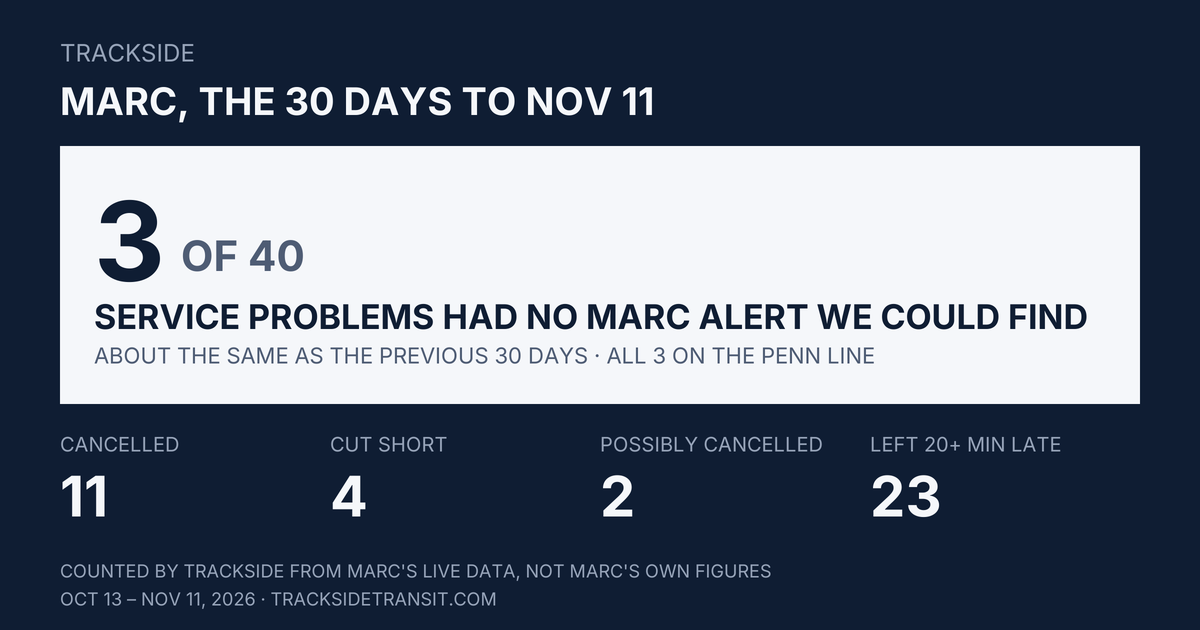
 Trackside
Service and tracking record
Last 30 days
Oct 13 – Nov 11 · 2,236 scheduled trips
Service
Tracking
Counted by Trackside from MARC’s live data, not MARC’s own figures. Our reading of that data can be wrong too, so tell us if you spot a mistake.
Service
Problems with the ride itself: a train that was cancelled, cut short, never tracked, or left 20+ minutes late.
“Possibly cancelled” means no train was ever tracked on it: often it didn’t run, so it sits here, but sometimes it ran untracked.
The No MARC alert tile shows how many of these riders weren’t told about.
Cancelled
The train was listed in MARC’s live data but never left its first station, or MARC marked it cancelled before it left.
It doesn’t mean MARC announced it: the No MARC alert tile counts the ones it didn’t.
Counted as a service problem, one per train per day.
Cut short
The train left its first station, then MARC cancelled the rest of the trip: its live data marked the remaining stops cancelled, or an alert said the train was terminated.
Riders waiting at the later stops got no train.
Counted as a service problem, one per train per day.
Possibly cancelled
MARC’s live data never tracked a train on it that day: the trip never appeared, or MARC listed it without a train.
Often it was cancelled, but sometimes it ran untracked, so we never say it didn’t run.
It may be a service problem, a gap in MARC’s live data, or Trackside misreading that data: we check, but can’t rule the last one out.
Left 20+ min late
The train left its first station 20 or more minutes after the published schedule.
It counts only a late start, not time lost along the way.
Counted as a service problem.
No MARC alert
A cancellation, a cut-short trip, an untracked train, or a 20+ min late start with no MARC service alert that day covering it.
A delay notice for a train that was never tracked counts as no alert: it didn’t say the train was cancelled.
It doesn’t judge an alert’s wording or timing, only whether one was posted.
Trackside matches alerts to trains automatically, so an alert worded in a way we don’t recognize can be missed.
Tracking
How well MARC reports where its trains are and when they’ll arrive. Trackside and other transit apps rely on those reports to show riders live positions and times.
The train itself may have run fine. When tracking fails, riders following it saw an out-of-date or wrong picture.
Vanished before arrival
The train dropped out of MARC’s live tracking before its last stop, so riders following it saw the countdown freeze or disappear.
The train itself kept going.
Counted as a live-data issue, not a service problem.
Position missing or wrong
MARC published no position for 15+ minutes while the train kept moving, or showed it in two places at once.
Riders saw the train stuck on the map, or jumping between places.
Counted as a live-data issue, not a service problem.
Times wrong or missing
The times MARC published were wrong: frozen for 15+ minutes while a shown time came and went, still “arriving” 20+ minutes after the train got in, or no times at all for a train that was running.
Counted as a live-data issue, not a service problem.